
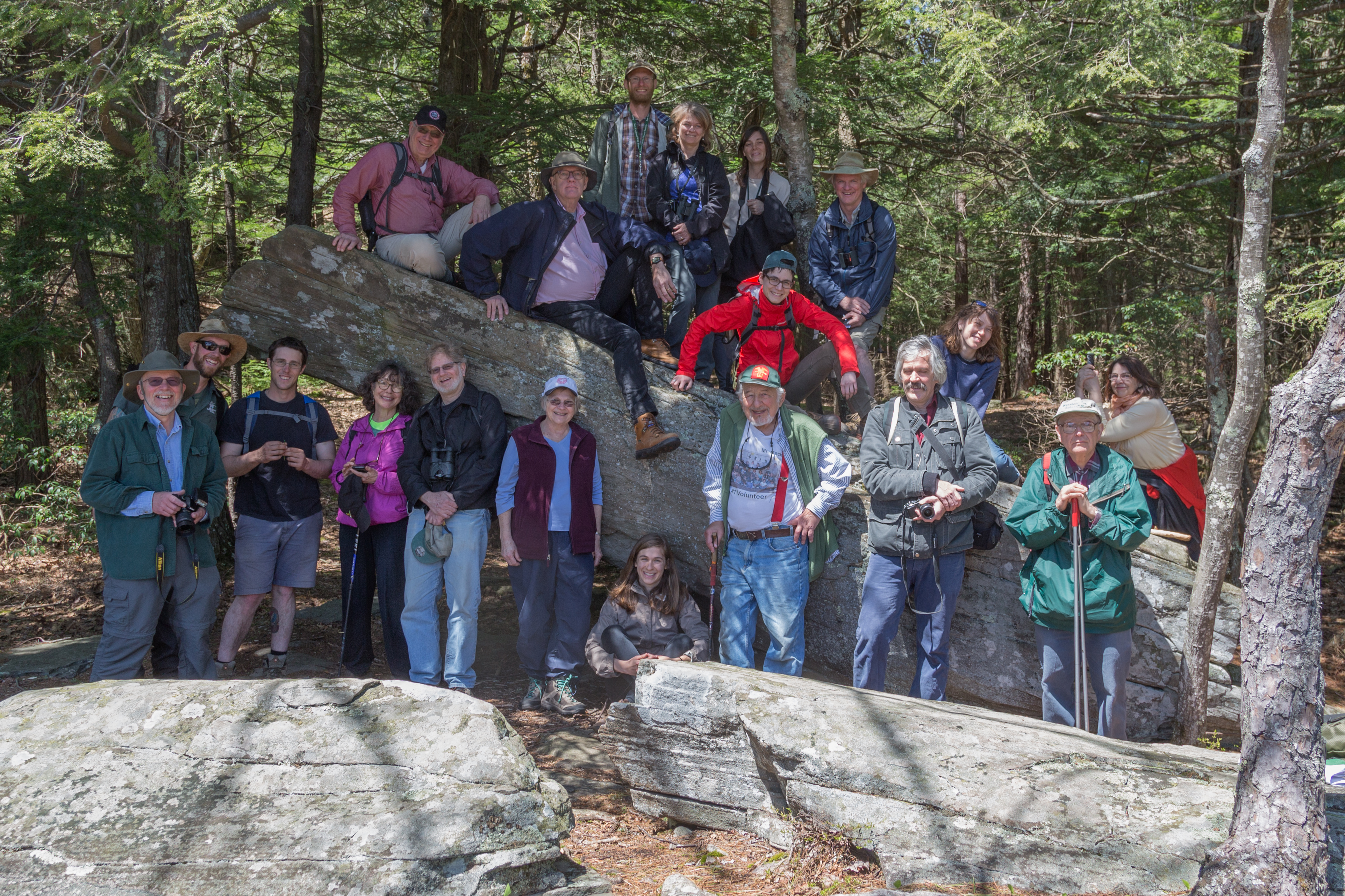
Field trips are one of the most important activities of the Society and participation is the best way to increase one’s knowledge of local plants. Most of the trips are for general study and monitoring of the flora and ecology of an area. Other trips are led by individuals who specialize in certain groups of plants and their trips are planned accordingly. While most trips emphasize plant study, other aspects of natural history and cultural heritage are not neglected. Trip participants are always free to ask questions about anything of interest they see. The leader or other members of the group can often supply an answer.
The location may be any place of botanic interest which is usually within 50 miles of New York City. We are not a hiking club and walking distances are usually not great. Those who come on the field trips are urged to participate in the Society’s other activities as well. Trips generally go rain or shine; if in doubt, check the website or contact the leader. Some trips are reachable only by automobile. Those in need of rides and those who are offering rides should post and check for messages on Torrey Botanical Society’s Facebook and Twitter sites or contact the trip leader. Those who use public transportation are advised to check updated schedules in advance. Interested guests and non-members are always welcome on field trips.
Upcoming Field Trips
Spring Wildflowers of Cunningham Park (Queens)
Sunday, May 3 @ 10AM
Register: https://www.eventbrite.com/e/spring-wildflowers-of-cunningham-park-tickets-1986953657878
Joint field trip with LIBS and North Shore Land Alliance, we will look for spring wildflowers in the richest forest in Queens.
Dr. Greller has been studying the flora and vegetation of Cunningham Park for more than 50 years. On this walk, he will provide a fascinating introduction to the native and naturalized plants of Cunningham Park, one of the richest forests on Long Island and an integral part of Queens County’s emerald necklace of 2800 acres of connected parkland. Andy has published three research papers that include data from Cunningham Park: one on forest flora, one on forest composition, and one on the entire recorded flora of northeastern Queens (ca.750 species). Spring is a delightful time to visit the park as many plants emerge from their winter dormancy.
Trip Leader: Andrew Greller
Meeting Location: In front of the concession stand in the parking lot behind the Cunningham Park Playground, east of the intersection of Aberdeen and 193rd St. (GPS Coordinates: 40°43’37.8″N 73°46’26.8″W, view location on Google Maps)
Public Transit Directions: From the last stop of F Train at Jamaica-179 Street, take the Flushing-bound Q17 bus and get off at 188 St/Avon Rd and walk east for 10 minutes to the playground at 193rd St.
Rare Plants of Fort Washington Park (Manhattan)
Sunday, May 10 @ 10:30 AM
Register: https://www.eventbrite.com/e/rare-plants-of-fort-washington-park-tickets-1986957914610
Rocky shores, rare plants, a light house, and view of the Palisades! Fort Washington Park is one of very few places where we can still see the natural shoreline of the island of Manhattan. The rocky coast and ridges in the park are the last refugia for a variety of locally rare species such as Fibrous-root Sedge (Carex communis) and the hemi-parasite Bastard Toadflax (Comandra umbellata). The shrub Nantucket Juneberry (Amelanchier nantucketensis) should still be blooming. This globally rare plant would the highlight for this field trip.
The park is also home to one of the last salt marshes in Manhattan. Here we’ll see the rare Seacoast Bulrush (Bolboschoenus robustus) and Big Cordgrass (Spartina cynosuroides) among the more common salt marsh graminoids. Notable bryophytes growing on moist slope include: Aulacomnium heterostichum, Radula complanata, Solenostoma hyalinum.
Please note: this is very difficult terrain – walking/scrambling on steep slopes and slippery rocky shoreline is required to see the target species.
Trip Leader: Zihao Wang
Meeting location: Plaza Lafayette, on the intersection of W 181st Street & Riverside Drive (in front of 875 W 181st Street, view location on Google Maps).
Plant walk at Clove Lakes Park (Staten Island)
Saturday, May 16 @ 1:00 PM
Join Torrey Botanical Society for a plant walk in Clove Lake Park, as part of the 2026 Staten Island Bioblitz. We will identify and document wildflowers, woody plants, mosses, lichens, and insects in the forest and lakeshores of the park.
Trip Leader: Zihao Wang
Meeting Location: Martling Avenue and Brooks Pond Place in Clove Lakes Park
Early summer sedges at Marshlands Conservancy (Rye)
Saturday, May 23 @ 10:30 AM
Register: https://www.eventbrite.com/e/early-summer-sedges-at-marshlands-conservancy-tickets-1986954344933
Join the Torrey botanical society as we explore Marshlands conservancy, a diverse 147-acre wildlife conservancy in Rye, NY. We will ramble along the Long Island sound shoreline in search of newly identified populations of rare sedges like Carex reznicekii, Carex emmonsii, Carex deflexa, and more interesting Section. Acrocystis members. We will also explore two unique islands containing brackish meadows, high and low salt marshes, and a coastal oak/ heath forest. We will be looking to catch the last blooms of Silene caroliniana ssp. pensylvanica and Oxalis violacea. Expect occasional off trail botanizing, and encounters with ticks as they can be abundant at the preserve. Please bring water, lunch, and bug spray.
Trip Leader: Julie D’Onofrio
Meeting Location: Parking lot in front of the visitor center of Marshlands Conservancy (GPS Point: 40.956181, -73.703674, view it on Google Maps)
Transit Directions: take the metro north to the Harrison train station and walk ~20 minutes to the preserve.
Wildflowers of Marine Park (Brooklyn)
Saturday, June 13 @ 9AM
Register: https://www.eventbrite.com/e/wildflowers-of-marine-park-tickets-1986956128267
Join Torrey Botanical Society and Marine Park Alliance for a wildflower walk in the park! We will look for wildflowers and insects in the largest city park in Brooklyn.
In the coastal dunes and meadows in the park, we will likely encounter blooming native species such as Asclepias syriacus (Common Milkweed), Linaria canadense (Blue Toadflax), Hudsonia tomentosa (Woolly Beachheather) and Krigia virginica (Dwarf Dandelion). A variety of nonnative plants will also be blooming, attracting insects which we will close examine.
This walk will last for 1.5 hours in a mostly open area, sun protection is highly recommended. Dress appropriately for the weather and bring plenty of water.
Trip Leader: Zihao Wang
Meeting Location: Salt Marsh Nature Center, 3301 Avenue U
Transit Directions:
Check back soon for more details on upcoming field trips, or become a member to receive updates via email!
Field trip leaders are asked to complete and submit a field trip reporting form which includes vegetation lists and notes on any new or unusual plants or vegetation types to the Field Chair, Zihao Wang. These trip reports, when submitted, will be made available as a year end field trip summary publication.
Please click on the link to access the field trip reporting form:
TBS Field Trip Instructions
Past Field Season Reviews: TBS 2016 Field Review & TBS 2017 Field Review

